Broken customer-action links that can stop booking, order, quote, and contact paths
Alternative guide
Use PageSpeed Insights for performance data. Use SiteLeak for lead-path evidence.
PageSpeed Insights is useful when you need lab and field performance data for a page. SiteLeak is narrower: it checks whether customers can still reach public forms, booking links, phone actions, menus, order paths, quote paths, and other lead paths. The right choice depends on the problem you are trying to confirm.
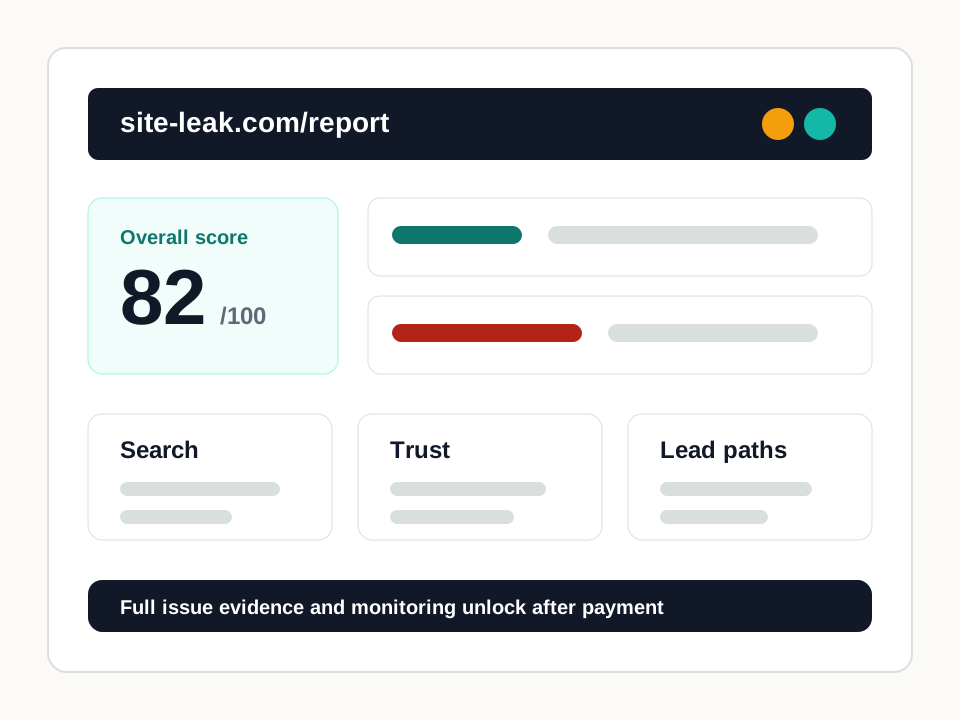
Customer-path evidence this page checks
Form and CTA signals that performance reports do not frame as lead-path evidence
Mobile first-screen action evidence when browser checks are available
Full report and monitoring paths for recurring checks
Public source URLs and issue IDs for handoff to a website maintainer
Different job to be done
Performance data can explain loading experience. Lead-path evidence explains whether a visitor can complete the business action the page asks them to take.
When both are useful
If a page loads slowly and the booking button also breaks, those are different fixes. Use a performance tool for load evidence and SiteLeak for customer-path evidence.
Why monitoring is different
A performance check is often run on demand. SiteLeak monitoring is for recurring evidence when public forms, links, scripts, and action paths change over time.
What this page helps you decide
Use this comparison when you are deciding whether the problem is page performance, customer-action reliability, or both.
Practical fixes after the scan
If SiteLeak finds a dead booking, order, quote, or contact path, fix the path before tuning lower-risk page details.
If PageSpeed Insights reports performance issues, route those findings to the developer or platform owner responsible for page weight and rendering.
If both reports show problems, separate the work into load-experience fixes and lead-path fixes so neither gets lost.
Use monitoring after the first repair when the customer path changes often.
Evidence examples
checkout.broken_booking_linkhigh
Booking link fails even if the page loads
The public page can load, but the booking CTA resolves to an error during customer-action link checks.
Fix: Update the booking URL or redirect and retest the customer path after publishing.
conversion.no_above_fold_ctamedium
Mobile page has no visible customer action
Browser evidence does not find a call, contact, booking, quote, order, or checkout action in the first mobile screen.
Fix: Move the primary action into the first mobile screen and retest the page with browser checks enabled.
conversion.form_submit_disabledhigh
Form submit action appears disabled
Static form evidence or browser evidence indicates a disabled submit action near the lead path.
Fix: Repair the form state, widget script, or required-field logic and retest without submitting customer data.
How to choose
Use SiteLeak when
- You need evidence for broken forms, booking links, quote paths, order links, phone actions, or mobile CTAs.
- You want a paid report with affected URLs, severity, fix steps, screenshot context where available, and PDF-ready handoff.
- You want weekly or daily rechecks for public customer paths.
Use the other tool when
- You need lab and field performance data for a page.
- You are investigating Core Web Vitals, Lighthouse metrics, or page-experience suggestions.
- A developer needs detailed performance suggestions for loading and rendering work.
Limits to keep fair
- SiteLeak does not replace dedicated performance tooling.
- PageSpeed Insights does not exist to prove whether a lead form, booking link, phone action, or order path works.
- Neither tool should be treated as a guarantee of revenue, ranking, compliance, or complete website quality.
Source context
Questions this scan can answer
Does SiteLeak replace PageSpeed Insights?
No. PageSpeed Insights is built for performance and page-experience data. SiteLeak is built for public customer-path checks and monitoring.
Should I run both?
Yes, if you care about both loading experience and whether contact, booking, order, or quote paths work.
Does SiteLeak use Core Web Vitals?
No. SiteLeak may record basic load and browser evidence, but it does not replace a dedicated Core Web Vitals workflow.