Broken customer-action links from public pages
Alternative guide
Use a crawler for deep site analysis. Use SiteLeak for customer-path checks.
Screaming Frog SEO Spider is a powerful desktop crawler for people who need detailed crawl data. SiteLeak is intentionally smaller: it gives a business owner a public scan, concrete lead-path findings, a paid report, and recurring monitoring without requiring crawler setup or manual spreadsheet work.
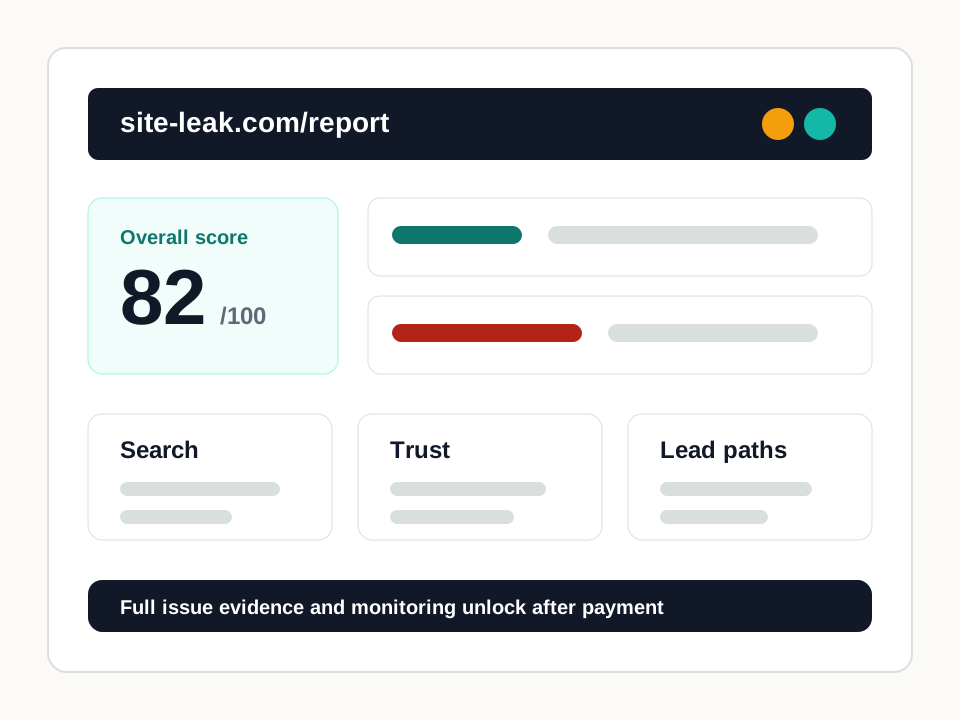
Customer-path evidence this page checks
Form, CTA, phone, booking, order, quote, and checkout signals
Plain-language issue rows for business owners and site maintainers
Self-serve checkout for full evidence and monitoring
No private-network scanning, form submission, or manual crawling workflow
Crawler depth versus self-serve evidence
A crawler can be excellent for detailed site inventories. SiteLeak focuses on a smaller set of public paths that directly support customer action.
Who should use which
Use Screaming Frog when an SEO specialist or developer is comfortable configuring crawls. Use SiteLeak when a small business needs a report they can understand and hand off.
Monitoring difference
SiteLeak is built around recurring scans, issue changes, and alerts for customer paths. The goal is to notice broken forms, links, and CTAs after routine site changes.
What this page helps you decide
Use this comparison when you need to decide between a specialist crawler workflow and a self-serve customer-path report.
Practical fixes after the scan
Use SiteLeak findings to repair broken customer-action links before lower-risk inventory cleanup.
Use crawler exports when a specialist needs page-level inventories, directives, metadata, and large crawl data.
Give SiteLeak paid reports to the person who owns customer experience, not only to the technical specialist.
Use monitoring after fixes when the business depends on recurring booking, order, quote, or contact paths.
Evidence examples
reliability.broken_linkhigh
Customer-facing homepage link returns an error
The sampled public link resolves to a same-domain URL that returns a failure status.
Fix: Repair the destination or add a redirect, then rerun the public scan.
conversion.phone_number_not_clickablehigh
Phone number is visible but not clickable
The public page includes a phone number but does not expose a matching tap-to-call link.
Fix: Wrap the phone number in a tel: link and confirm it appears near the customer action.
security.mixed_content_hintmedium
Secure page references insecure assets
The scanned HTTPS page includes an HTTP asset reference in the public HTML.
Fix: Move the asset to HTTPS or remove it, then retest the page.
How to choose
Use SiteLeak when
- A nontechnical owner wants a quick public report focused on contact, booking, order, quote, and CTA paths.
- The business wants weekly or daily evidence checks without manually configuring a crawl.
- The paid deliverable needs to be a concise handoff with issue IDs, affected URLs, severity, and fix steps.
Use the other tool when
- A specialist needs broad crawl data, exports, directives, metadata inventories, or custom crawl configuration.
- The project involves many page types and a technical team will inspect the crawl in detail.
- The priority is deep site analysis rather than a self-serve lead-path report.
Limits to keep fair
- SiteLeak is intentionally smaller than a desktop crawler.
- A crawler can surface issues SiteLeak does not attempt to inspect.
- A crawler report may still need business-language interpretation before a small-business owner can act on it.
Source context
Questions this scan can answer
Is SiteLeak a crawler replacement?
No. SiteLeak is a lead-path scanner and monitor. A desktop crawler is still useful for deep site inventories and specialist workflows.
Why would an agency use both?
An agency can use a crawler for broad technical investigation and SiteLeak for a client-facing lead-path report and recurring customer-path checks.
Does SiteLeak crawl every page?
No. SiteLeak samples public paths and focuses on actionable customer-path evidence rather than exhaustive crawling.